
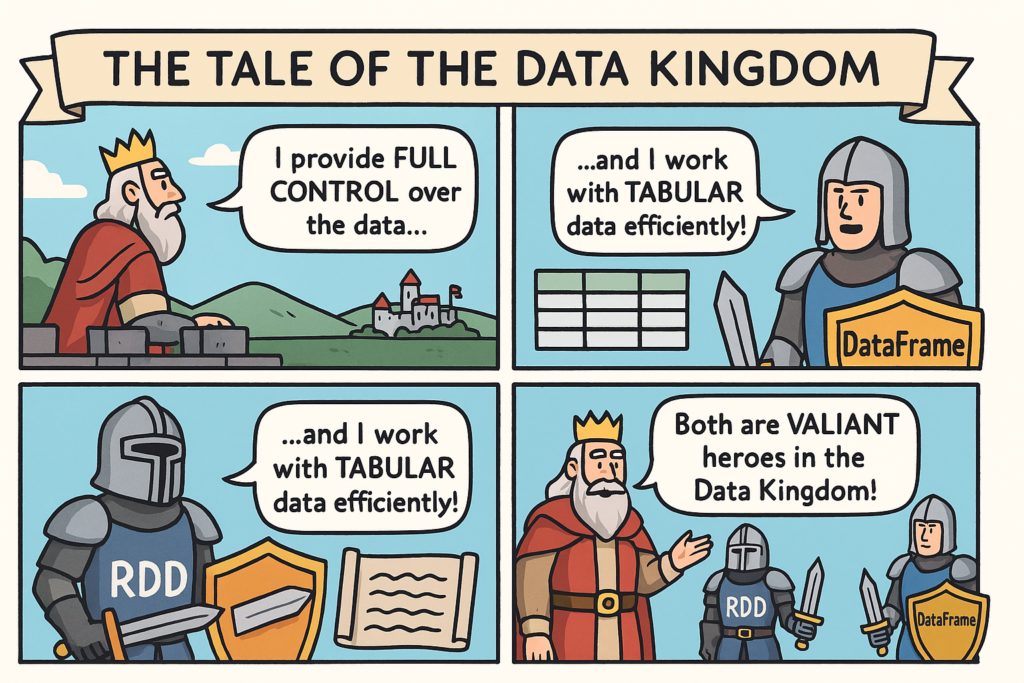
Apache Spark provides multiple ways to process big data, and two of its most commonly used abstractions are RDDs and DataFrames. Although they belong to the same ecosystem, each serves different purposes and is suited for different kinds of workloads. RDDs, or Resilient Distributed Datasets, were Spark’s original abstraction. They allow you to work with data at a very low level, meaning you control exactly how each record is processed. This makes RDDs flexible and powerful when dealing with raw, unstructured information. However, because Spark does not know the structure of the data inside an RDD, it cannot optimize the execution plan. As a result, RDD operations tend to be slower and require more code to implement.
DataFrames were introduced later to simplify working with structured or semi‑structured data. A DataFrame looks like a table with rows and columns, similar to a spreadsheet or a SQL table. Because a DataFrame has a known structure, Spark can analyze the logic you write and automatically optimize it using internal tools like the Catalyst optimizer and Tungsten execution engine. Catalyst rewrites your operations into a more efficient sequence, while Tungsten executes them in a highly optimized manner using efficient memory formats and generated code. This is why DataFrames usually run much faster than RDDs and require far less manual work.
A simple way to understand the difference is to imagine that RDDs require you to manually handle every detail of the data, while DataFrames allow Spark to take care of most decisions for you. DataFrames provide a more user-friendly interface, allowing you to write code similar to SQL, which makes them much easier for beginners and significantly more efficient for analytical or ETL tasks. RDDs still play an important role, especially when the data is messy or when the processing requires custom logic that cannot be expressed easily with DataFrame operations.
Real‑world use cases help clarify where each abstraction fits. Consider a company that processes millions of log files generated by web servers every day. These log lines may contain inconsistent formats, missing pieces, or unusual characters. To clean and parse this kind of unstructured data, engineers often use RDDs because they give full control over how each line is handled. For example, a cybersecurity team analyzing intrusion attempts might load raw firewall logs using RDDs so they can manually split text, filter suspicious patterns, and extract fields that do not follow a fixed schema. Another example is when processing scientific simulation data, which may consist of binary files or custom-encoded formats. These datasets often require very specific decoding logic that is much easier to implement using RDDs than DataFrames.
On the other hand, DataFrames dominate the world of structured data analytics. For example, an e‑commerce company might store customer orders, product details, and transaction histories in JSON or Parquet format. Because these datasets have consistent columns such as order_id, user_id, and amount, DataFrames are ideal. Analysts can quickly filter for high‑value customers, calculate daily revenue, or join multiple datasets—all while benefiting from Spark’s internal optimizations. In financial institutions, DataFrames are commonly used to process massive volumes of trading data throughout the day, enabling teams to compute risk metrics or generate regulatory reports much faster than traditional systems. In health‑tech companies, DataFrames are often used to analyze patient records or device telemetry data where the schema is known and performance is critical.
Choosing between RDDs and DataFrames depends heavily on the type of data and the task at hand. If the information is raw, unstructured, or requires highly customized processing logic, RDDs give you the control you need. But if the data is structured and your goal is to perform analytics, reporting, or large-scale transformations, DataFrames provide a cleaner, faster, and more optimized way to work. Thanks to Catalyst and Tungsten, DataFrames not only simplify the code but also significantly boost performance by automatically optimizing the execution path.
Ultimately, most modern Spark workloads rely heavily on DataFrames because of their efficiency and ease of use, while RDDs remain essential for specialized tasks requiring low-level manipulation. Understanding both helps developers make informed choices and build scalable, high‑performing data pipelines.
—***—
DataCognate Post